Bedding · Materials & Standards
Organic Cotton Bedding Layers: What GOTS Certification Does—and Doesn’t—Tell You
A label can tell you something important about how a textile was made. It cannot tell you whether the pad will feel plush, fit a deep mattress, or emerge from the washing machine looking quite as it did before.
There is a small drama played out whenever someone buys bedding. A person wants a softer bed, or a cleaner one, or simply one that feels less like a minor negotiation with the climate at three in the morning. The shopper encounters a word—organic—and then, nearby, a reassuring cluster of others: cotton, natural, breathable, certified. It is tempting to treat the cluster as a verdict. In fact, it is more like the beginning of an inquiry.
For organic cotton bedding, one of the most useful labels to understand is GOTS, the Global Organic Textile Standard. It is a certification framework for textiles made with organic fibers. Its reach extends beyond the field where cotton is grown, addressing parts of textile processing and manufacturing as well. That breadth makes the certification meaningful. It also makes the limits worth understanding. GOTS does not promise that a mattress pad will be cool, feather-soft, durable for a particular number of years, or ideal for every sleeper. Those are separate questions, answered by the materials, construction, fit, care instructions, and the person lying beneath the sheets.
This distinction matters because a bedding layer is not a single thing. A mattress pad may have a cotton shell and a cotton filling; another may have a cotton cover around down, wool, polyester, or foam. A protector can be made from cotton but include a waterproof membrane. A cover may be certified while the fill is not—or the finished product may be certified under a standard that covers its components and processing. The label is a useful map, but it is not the terrain.
What GOTS is designed to cover
GOTS is a textile standard built around the processing and labeling of textiles made from organic fibers. In broad terms, it establishes requirements for the organic status of the fibers and sets criteria for the stages of textile production within its scope. These can include processing, manufacturing, packaging, labeling, and distribution. Environmental and social criteria are also part of the standard, alongside restrictions on certain chemical inputs used in production.
That is a more substantial claim than a product simply being described as “natural.” The word natural has no single, universal meaning in bedding marketing. It may refer to one material in a product that contains several others, or it may be used as an impression rather than a precise specification. A certification, by contrast, points to defined requirements and a system of assessment. It gives shoppers a basis for asking what was verified and by whom.
GOTS labeling also distinguishes between different levels of organic fiber content. The precise label language matters: a textile described as “organic” is subject to a different minimum organic-fiber threshold from one described as “made with organic” materials. Shoppers should consult current GOTS labeling rules and the product’s certification information rather than infer the percentage from the word alone. A product’s certification scope, label category, and documentation are more informative than a broad claim printed on a hangtag.
The certification is not a statement that every item bearing cotton is wholly organic, nor does it certify every product made by a company. Certification applies within a defined system and scope. A manufacturer may produce both certified and uncertified goods; a supplier may handle a range of materials. When the distinction matters, look for the certification claim attached to the specific finished product and, where available, the certifier or license information. A logo can be a prompt to verify, not a substitute for verification.
What the label cannot settle
Certification answers questions about standards and supply-chain practices. It does not run a hand over the fabric on your behalf. It does not measure how much cushioning you will feel through a sheet, whether the pad will stay put on a mattress with a thick pillow top, or how quickly the filling will compress under repeated use. It does not determine that one sleeper will be cooler than another.
Comfort depends on a tangle of variables: the type and construction of the textile, the amount and distribution of fill, the mattress beneath it, the room’s temperature and humidity, sleepwear, bedding above it, and individual preference. Cotton is often valued for its familiar hand and moisture absorption, but “cotton” alone does not specify how a particular layer will feel. A closely woven percale cover, a smooth sateen, and a lofty cotton batting are different experiences, even when the same fiber appears in each.
Nor does GOTS certify a product as hypoallergenic or guarantee that it will relieve pain, prevent overheating, or improve sleep. Those are performance or health claims, and they call for evidence specific to the product and the claim. Someone with a known allergy or sensitivity may need to consider all components—not just the shell—and seek advice from a qualified clinician when appropriate. Organic certification can be relevant to a shopper’s material preferences, but it should not be treated as a medical assurance.
Environmental responsibility is similarly complicated. Organic-fiber standards and processing criteria provide meaningful information, but a certification is not a complete accounting of a product’s total environmental footprint. It does not, by itself, tell you everything about transport, product lifespan, packaging, laundering frequency, repairability, or what happens at the end of the item’s useful life. Those factors belong to the larger story. A well-made layer that is cared for and used for a long time may have a different practical impact from a short-lived one, regardless of how satisfying its label looks in the shop.
Cotton fill and cotton cover are not the same thing
When comparing cotton-filled bedding layers with cotton-covered ones, begin by identifying what each component does. The cover is the fabric closest to the sleeper. It influences the surface feel, the way air and moisture move through the layer, and how the filling is contained. The fill supplies most of the loft or cushioning. A pad with a cotton shell and a different fiber inside may have a very different profile from one filled with cotton.
Cotton batting can provide a modest cushion, though its loft and resilience depend on the quantity of fill, how it is processed, and how it is secured. Quilting helps prevent the filling from shifting into a few lumpy districts over time. The pattern and spacing of the quilted sections are therefore not merely decorative decisions; they influence how evenly the filling is distributed. A thin cotton pad may add a little softness without dramatically changing the feel of the mattress. A thicker construction may alter the surface more noticeably, though it still cannot transform a mattress whose support is no longer suitable.
A cotton cover, meanwhile, may be paired with another filling altogether. The fabric can feel breathable and familiar, but it does not tell you whether the layer beneath it is down, wool, latex, or synthetic material. The phrase “cotton mattress pad” is sometimes used loosely, so check the materials list for both shell and fill. If the product description names cotton only in the cover, do not assume the entire pad is made from cotton.
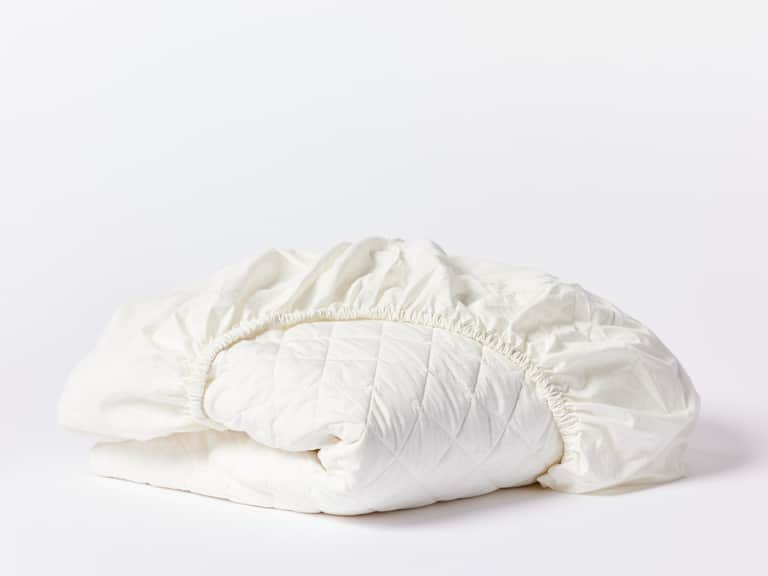
For a concrete example, the Organic Cotton Mattress Pad is described as using organic cotton batting and a percale cotton cover. Its construction includes quilted squares, full elastic, and pockets designed for mattresses up to 15 inches deep; the listed care instructions call for a cold, gentle wash and low-heat drying. The product information also identifies GOTS certification. These details answer different questions: the certification concerns standards, the material list identifies the components, the quilting describes construction, and the pocket depth helps a shopper assess fit. None should be asked to do the work of the others.
Breathability is not a single measurement
“Breathable” is one of those words that seems to explain itself until a warm night arrives. In bedding, it usually gestures toward the ability of a material or construction to allow air and moisture to move, but the experience of sleeping cool is not determined by a fiber name alone. Weave, thickness, fill density, mattress construction, room conditions, and the rest of the bedding all play their parts.
Cotton can absorb moisture, and a light cotton layer may feel different from a thick, densely filled one. A waterproof barrier can change how air and moisture pass through a protector, even if the surface fabric is cotton. Likewise, a quilted pad may trap more warmth than a thin fitted cover simply because it adds more material. “Organic cotton” describes the fiber’s certification status; it does not specify a temperature rating or promise a particular sleeping climate.
For readers who tend to sleep warm, a practical comparison begins with construction. Ask how thick the layer is, what the fill is, whether there is a waterproof membrane, and whether the cover is tightly woven or more open. Consider the sheet and duvet as part of the same system. A mattress pad is one layer in a small domestic weather pattern, not a thermostat with elastic corners.
Fit, quilting, and the unglamorous arithmetic of care
A bedding layer must fit the mattress it is meant to cover. Pocket depth is a specification with real consequences: a fitted skirt made for a shallower bed may pull loose over a tall mattress, while an oversized fit can wrinkle or shift. Measure the mattress from its base to the top surface, including any existing topper, and compare that number with the product’s stated pocket depth. If a pad is designed to stretch, its fit may be more forgiving, but the product details still deserve attention.
Quilting can help hold fill in place, but it also creates a pattern of seams and compartments that affects the surface. Larger quilted squares may permit broader movement of the batting; smaller ones can distribute it more frequently. Neither design is automatically superior. The relevant questions are whether the pad feels even, whether the fill tends to migrate, and whether the construction suits the way the bed is used.
Care instructions should be read before purchase, not after a spill has transformed the bedroom into a hurried research library. Cotton-filled pads may be washable, but washing conditions matter. A gentle cycle, low heat, a large-capacity machine, or prompt removal from the dryer may be specified for a reason. Heat, agitation, bleach, and fabric softener can affect textile fibers or construction. A large pad may not fit comfortably in a home machine, and repeated laundering may gradually change its loft or shape. “Machine washable” is not the same as “indifferent to washing.”
Washability is also distinct from protection. A pad may help shield a mattress from everyday dust and wear, but unless the manufacturer specifies a waterproof barrier, it should not be assumed to guard against spills. A zippered encasement, fitted protector, and cushioned mattress pad serve overlapping but different purposes. It is possible to want all three, though adding layers changes the feel and fit of the bed.
A clear-eyed way to read an organic bedding claim
When evaluating organic cotton bedding, it helps to divide the decision into three columns: certification, construction, and use. The first concerns what standards apply and how the claim is documented. The second concerns what the product is actually made of and how its components are assembled. The third concerns whether it works for a particular bed, sleeper, and care routine.
- Check the exact claim. Note whether the finished product is described as certified organic or made with organic fibers, and look for product-specific certification information.
- Read the component list. Identify the shell, fill, skirt, backing, and any membrane separately. “Cotton” on the label may refer to only one part.
- Look at construction. Quilting, fill quantity, thickness, and elastic design influence cushioning, stability, and the way the pad sits on the mattress.
- Measure before ordering. Compare mattress depth—including toppers—with the stated pocket depth or fitted dimensions.
- Study the care label. Washing and drying requirements affect convenience and may influence how the pad holds its shape over time.
- Separate standards from performance claims. Certification does not establish that a pad is cooler, softer, more durable, or medically beneficial for every user.
This method is less romantic than buying a product because its label seems to promise a cleaner conscience and a better night. It is also more useful. Organic certification can offer real information about fiber sourcing and textile processing, and GOTS provides a structured way to assess those claims. The careful shopper neither dismisses the label nor asks it to certify the entire experience of sleeping.
The useful promise—and the honest limit
Bedding is intimate, but its language is often expansive. A small rectangle of cotton batting is asked to stand for comfort, health, sustainability, craftsmanship, and the possibility of waking up as a person with excellent habits. Certification can bring needed specificity to that language. It can help distinguish a documented standard from a vague appeal to nature. It cannot remove the ordinary uncertainties of texture, fit, maintenance, and preference.
That is not a weakness of certification. It is simply the boundary of its job. GOTS tells a shopper something about organic fibers and the standards governing textile processing within the certification system. Product specifications tell the shopper what the layer contains and how it is built. A trial, where available, tells the sleeper whether it feels right. Care instructions offer a forecast of the relationship to come.
In the end, the best bedding decision is often made through a modest act of attention: read the label closely, notice what it leaves unsaid, and compare that with the details that matter in your own room. The word organic may open the door. The fiber list, quilting, pocket depth, and wash instructions are what let you walk through it without tripping over the bed.